
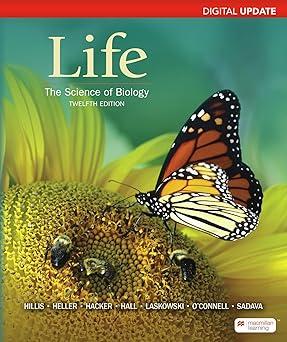
Life: The Science of Biology Digital Update

Life: The Science of Biology Digital Update

1 in stock

د.إ380.00

  • What is life? Living organisms are organized, use energy, maintain internal balance (homeostasis), grow and develop, reproduce, respond to their environment, and evolve over time.
  • Evolution: Evolution by natural selection is presented as the unifying principle that explains both the diversity and the similarities among living things.
  • Levels of biological organization: Biology can be studied from molecules and cells to organisms, populations, ecosystems, and the entire biosphere.
  • The scientific method: Scientists make observations, ask questions, develop hypotheses, test them through experiments or observations, analyze data, and revise their explanations based on evidence.
  • Cells: All living organisms are composed of one or more cells, which are the basic units of life.
  • Biological information: DNA stores hereditary information that is passed from one generation to the next.
  • Energy and matter: Living organisms require energy and transform matter to grow, survive, and reproduce.
  • Biology in everyday life: The introduction highlights how biology helps address challenges such as disease, climate change, food security, biodiversity conservation, and biotechnology.

Overall, the introduction prepares readers for the rest of the textbook by presenting the core concepts that connect all areas of biology and by emphasizing evidence-based scientific thinking.
1 in stock

Add to wishlist
SKU: 9781319498535 Category:
  • What is life? Living organisms are organized, use energy, maintain internal balance (homeostasis), grow and develop, reproduce, respond to their environment, and evolve over time.
  • Evolution: Evolution by natural selection is presented as the unifying principle that explains both the diversity and the similarities among living things.
  • Levels of biological organization: Biology can be studied from molecules and cells to organisms, populations, ecosystems, and the entire biosphere.
  • The scientific method: Scientists make observations, ask questions, develop hypotheses, test them through experiments or observations, analyze data, and revise their explanations based on evidence.
  • Cells: All living organisms are composed of one or more cells, which are the basic units of life.
  • Biological information: DNA stores hereditary information that is passed from one generation to the next.
  • Energy and matter: Living organisms require energy and transform matter to grow, survive, and reproduce.
  • Biology in everyday life: The introduction highlights how biology helps address challenges such as disease, climate change, food security, biodiversity conservation, and biotechnology.

Overall, the introduction prepares readers for the rest of the textbook by presenting the core concepts that connect all areas of biology and by emphasizing evidence-based scientific thinking.

Reviews

There are no reviews yet.

Only logged in customers who have purchased this product may leave a review.

Start typing and press Enter to search

Shopping Cart

No products in the cart.